

More than Fifty International Artists Shatter Expectations at the Biennial of Glass Arts in Cartagena
More than fifty artists gather at Cartagena’s glass art biennial, where Angela Castro Fenix, Núria Torrente, and Carolin Zibulka explore memory, perception, and the uneasy relationship between seeing and knowing, making transparency far less straightforward than its polished reputation suggests.
Letters With Something to Hide
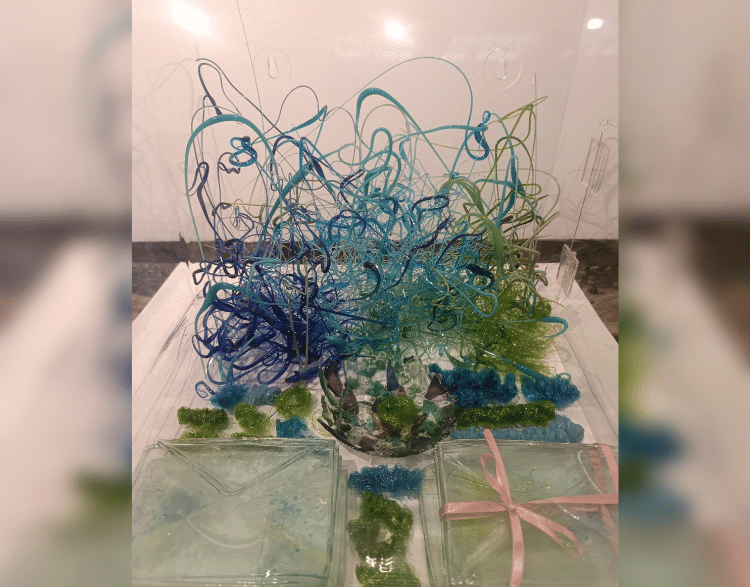
A pink ribbon ties everything up nicely. Almost. In Angela Castro Fenix’s Mailbox: Women’s Secrets, transparent envelopes sit in orderly stacks while blue, turquoise, and green filaments climb into a restless tangle behind them. The arrangement promises safekeeping. Its unruly lines suggest that what has been preserved will resist being contained.
The installation belongs to “Territorios Invisibles,” the central exhibition of Colombia’s third Biennial of Glass Arts, curated by Cristine Baena at the Museo de Arte Moderno de Cartagena Enrique Grau. Opened October 15 and running through November 13, 2026, the international exhibition brings together more than fifty artists investigating glass beyond its familiar decorative uses.
Castro Fenix’s strongest device is spatial. Horizontal envelopes establish order; rising loops undo it. Cobalt gathers at the left, green at the right, with turquoise crossings complicating the middle. Following one strand becomes difficult. The eye experiences something like the frustration of reconstructing a memory from fragments that refuse to line up.
The glass envelopes deepen that uncertainty. Their transparency promises disclosure without offering a readable narrative. Meanwhile, the pink bow makes affection and restraint almost indistinguishable. Its sweetness can be read as a demand that women’s histories arrive tidily packaged.
The artist links six sculptures to historical women, including Débora Arango and Policarpa Salavarrieta. Their different struggles sharpen the installation’s stakes: Arango challenged restrictions on women’s artistic expression, while Salavarrieta carried intelligence for the independence cause. Here, correspondence can suggest both private attachment and dangerous public agency.
Three Ways of Looking Through
Spanish artist Núria Torrente approaches visibility through La Frontera de lo Invisible. Her slender, upright sculpture combines glass fusion, transferred imagery, heat shaping, and flame working. In the published photograph, facial imagery appears within the transparent form, interrupted by a red line. Recognition feels tentative, as though a person might emerge only to slip behind the material again.
At 45 centimeters tall, the work invites close attention. Its narrow proportions focus the encounter; the red accent arrests the eye, while the surrounding clarity lets it wander. Read alongside Castro Fenix’s proliferating strands, Torrente’s restraint suggests another difficulty of remembrance: sometimes the obstacle is an image too elusive to hold.
Carolin Zibulka’s selected work, Dual Texture, introduces a different question: which surface are we actually seeing? Her documented process, called Lavacoating, offers a way into that title. She builds layers of materials on the reverse side of the glass, letting each dry before sealing the work. The finished effect becomes apparent when the panel is turned over.
That reversal gives the title an intriguing tension. The viewer encounters a glass surface while looking toward structures made behind it. Texture becomes something perceived across a separating layer. Where Castro Fenix’s threads occupy space and Torrente’s imagery inhabits a transparent form, Zibulka’s process places the labor of making on the far side of the viewing surface.
Together, these approaches give the gathering’s international scale substance. Cartagena becomes a place where different studio traditions test the same assumption: that clarity guarantees access. Castro Fenix supplies the most intimate reminder. Her envelopes remain visible, carefully kept, and stubbornly closed.
Photo: Angela Castro Fenix “A Woman’s Secrets”- Fused glass


0 comments