


Puerto Rican Artist Edra Soto Opens New Doors Through the Art of Fences
Edra Soto transforms Puerto Rican domestic screens into installations that make boundaries visible, porous, and unexpectedly intimate. Across water, gardens, and museum walls, her geometric patterns ask how home travels, who preserves its meaning, and what belonging looks like elsewhere.
A House Without Dry Ground
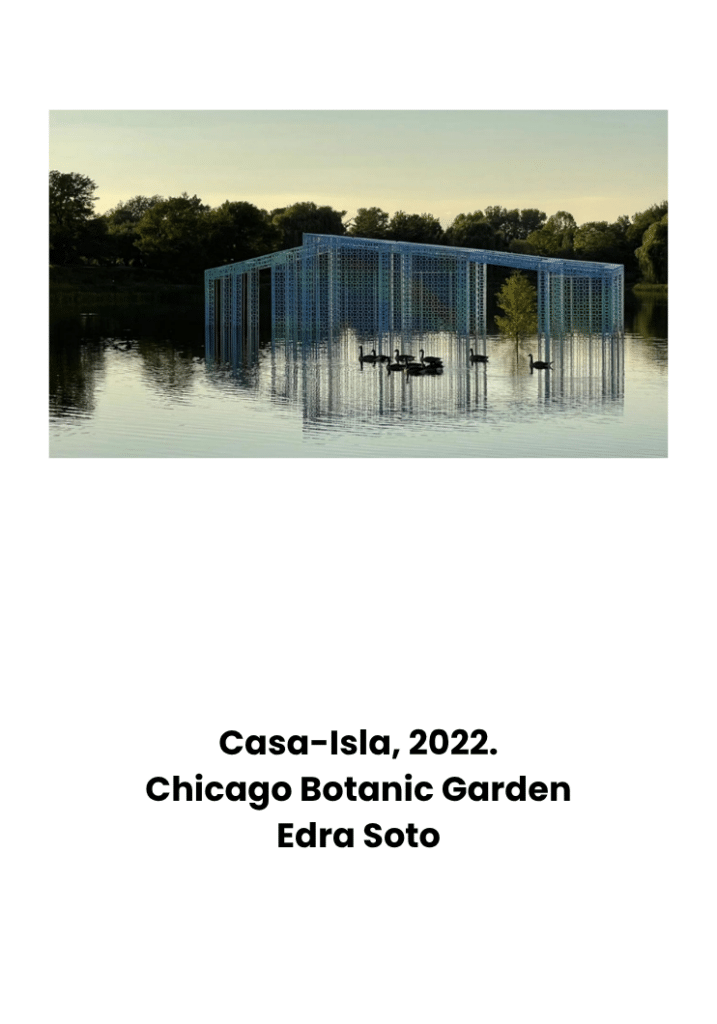
The house stands in water. Its pale framework admits the trees behind it, while geese pass across the foreground. In Casa-Isla / House-Island, installed at the Chicago Botanic Garden in 2022, Edra Soto makes domestic architecture recognizable without making it habitable. The welcome is visual. There is no visible dry floor.
The horizontal span matters. Rather than reaching upward like a monument, the structure spreads across the lagoon, its angled outline countering the upright trees. Small geometric openings repeat across larger rectangular frames. Seen together, these two scales make the work oscillate between intimate household detail and something approaching an island’s silhouette. Soto’s project description connects its horizontal forms to Puerto Rico’s topography and the house as a vessel for private histories. Soto specifies three colors of house paint, applied with rollers and blended like watercolor. That domestic material choice matters: a substance associated with maintaining a home helps turn its remembered outline into something atmospheric rather than structural.
Water supplies another version of the structure. Above the surface, lines appear measured and stable; below, their reflections stretch into wavering threads. The eye moves between construction and dissolution. This is not simply a beautiful backdrop. The setting changes what the geometry can do, making a fixed pattern depend on an unstable surface.
The image can suggest vulnerability, but it need not illustrate a particular disaster. Its compelling uncertainty concerns access. We can see almost everything through this house and still cannot occupy it from where the photograph places us. Home appears both available and distant, an apt visual condition for thinking about memory across water.
The Fence Keeps Its Address
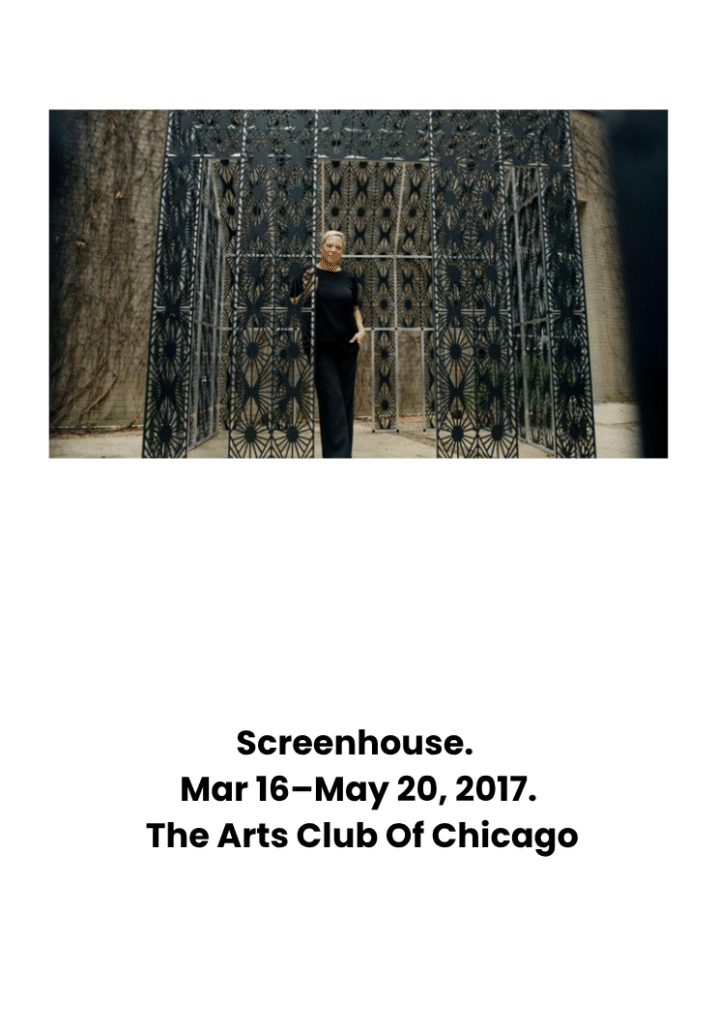
That negotiation between openness and enclosure runs through GRAFT, Soto’s continuing investigation of the patterned rejas found around Puerto Rican homes. In Screenhouse, shown at the Arts Club of Chicago in 2017, black radiating lines gather around dark circular centers. Their repetitions produce diamonds, fans, and overlapping starbursts. The Arts Club describes the freestanding work as a social structure informed by garden gazebos.
Here, the pattern does not merely decorate architecture. It constructs it. Narrow uprights and a broad upper band establish the outline of a room, while openings interrupt the dense lattice at bodily scale. An adult standing within the structure gives those openings immediate proportion. The screen can look imposing from a distance, then delicate where its slender lines cross the surrounding space.
Front and rear panels complicate the view. Their geometries overlap rather than resolving into one flat design. Brickwork and climbing stems remain visible beyond them, making a background that refuses to disappear. The sculpture asks us to look at its surface and through it, two activities that do not quite coincide.
Yet treating these works as salvaged ironwork would miss an important distinction. In her United States Artists interview, Soto explains that iron is costly and insufficiently flexible for her daily experimentation. She also refuses to remove original fences from homes to supply her art. Their household setting reflects cultural value. She makes representations instead. Pasted markdown
That decision gives the practice an economic and ethical specificity. The ordinary house is not simply a warehouse of forms available for extraction. Its existing use matters. Soto’s representation carries a pattern elsewhere without requiring the household to surrender the object that made the pattern meaningful.
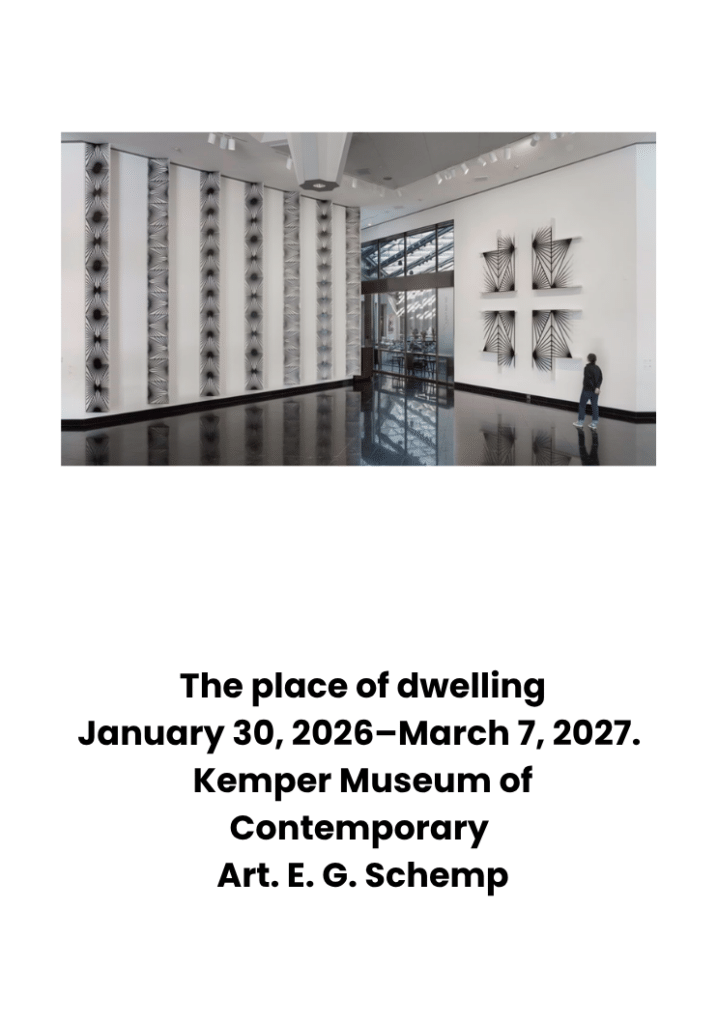
At the Kemper Museum in 2026, the place of dwelling extends this vocabulary vertically. Long patterned strips ascend the atrium wall, alternating with intervals of white. Across the adjoining wall, four projecting constructions surround a cross-shaped gap. Their radiating lines direct attention toward both dark centers and space. The glossy floor returns these arrangements as reflections, extending the composition beneath the viewer.
Compared with Screenhouse, this installation offers less enclosure and more rhythm. Repetition measures the museum’s height; the small figure in the photograph makes that scale bodily. The exhibition description connects the commission to Soto’s Catholic upbringing and the relationship between sacred architecture and museums. That context gives the cross-shaped absence significance without making every geometric motif a religious symbol.
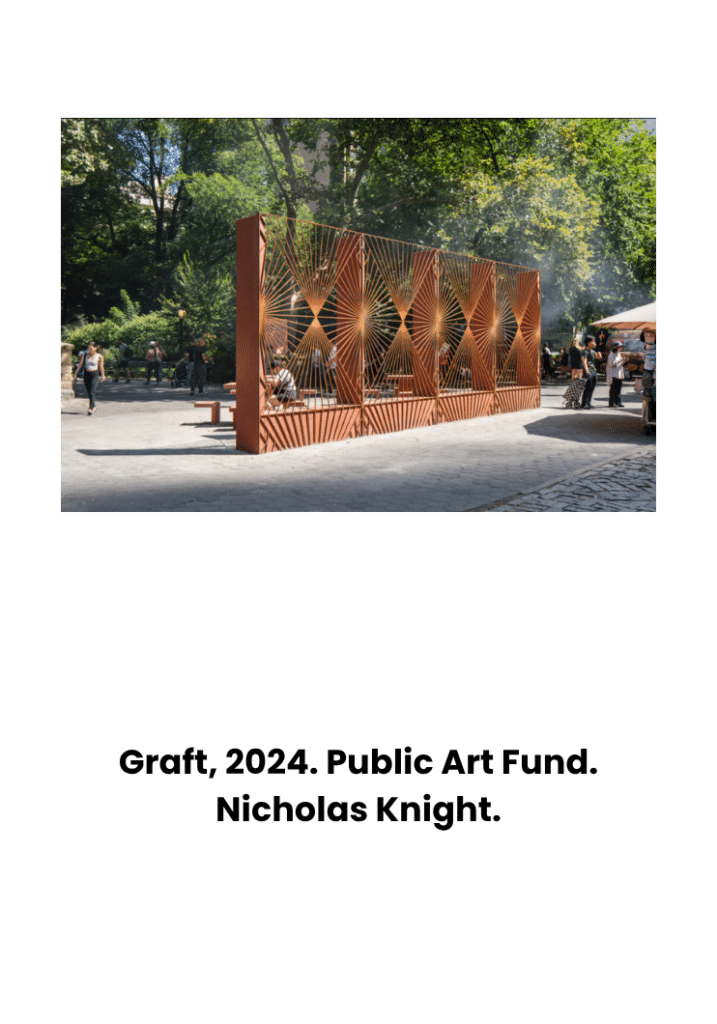
The supplied photographs repeat this atrium view; the fourth does not document the separately captioned New York Graft. Public Art Fund’s account identifies the 2024–2025 project as a corten steel and terrazzo structure with tables and seating. There, a household facade becomes somewhere to pause, not merely an image to admire.
Across these settings, the strongest continuity is not an unchanged material or identical pattern. It is Soto’s sustained attention to how a boundary becomes meaningful through use. Her interview resists treating Latinx culture as a single unit. The Puerto Rican specificity of these screens matters precisely because geometric design can otherwise become anonymous. Pasted markdown
What remains is the familiarity of a threshold: somewhere to stand, look outward, and notice another person. Soto enlarges that modest experience without entirely monumentalizing it. Water unsettles the house; overlapping screens complicate the garden; reflected patterns loosen the museum wall. Architecture becomes memorable not because it shuts the world out, but because it gives contact a particular shape.