


Colombian Artist Lilian Espinosa Lets Flowers Rewrite Faces and Gives Blessings a Twist
Lilian Espinosa’s paintings bring restless flowers and crowded portraits into the same chromatic world. Through looping brushwork, divided faces, and a mischievous Spanish title, the Colombian artist makes ornament carry the difficult balance between individual presence and belonging to others.
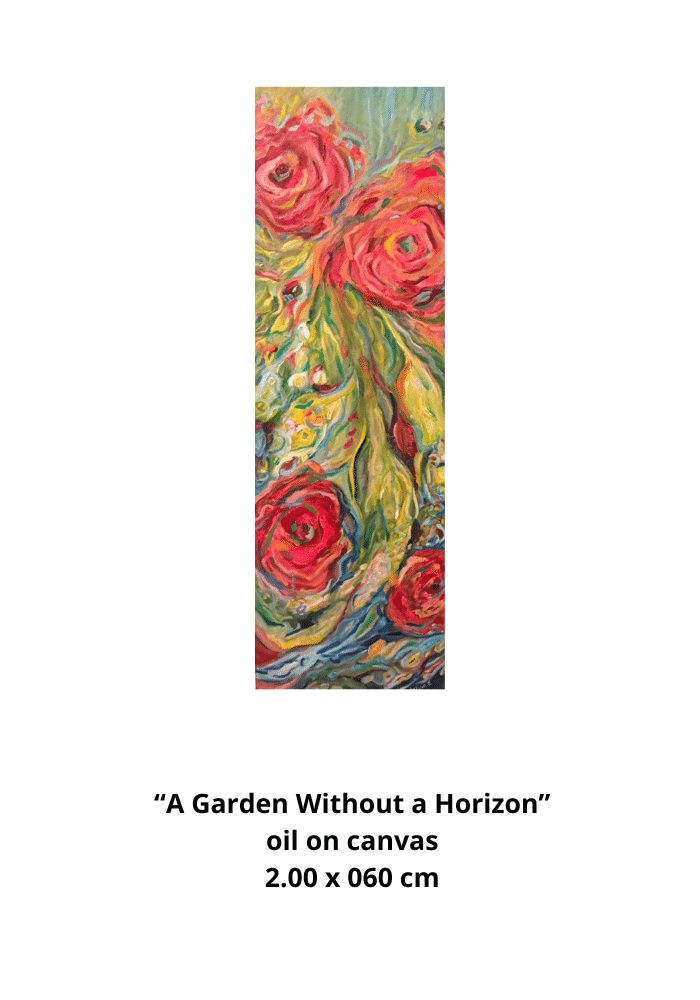
A Garden Without a Horizon
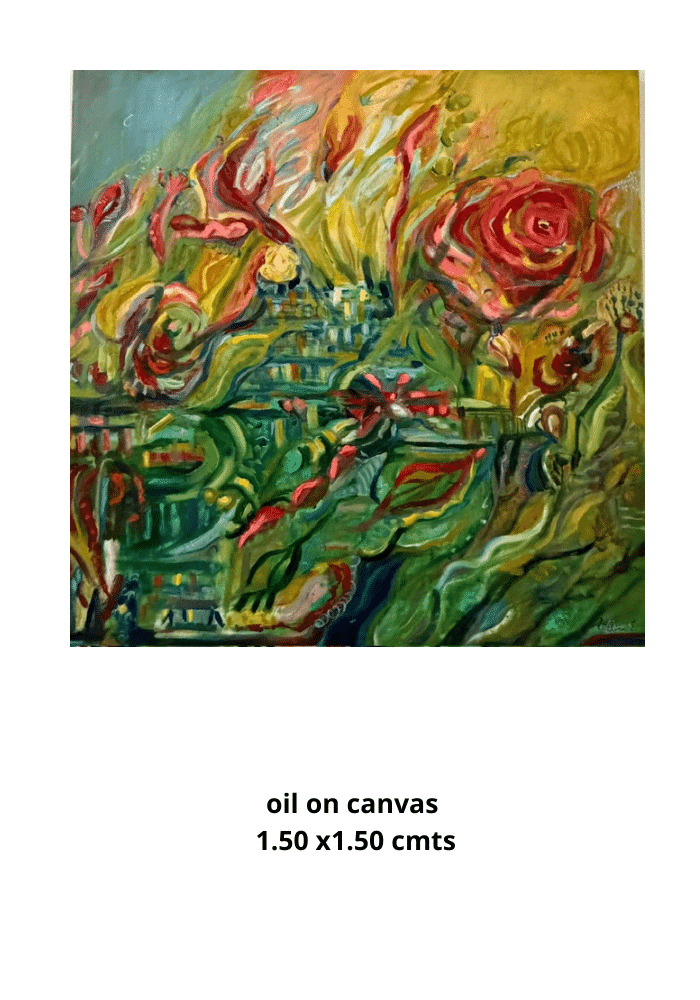
A red flower opens near the upper right of Lilian Espinosa’s densely worked square composition. But try following its stem. The line slips into green currents, crosses blue horizontal bars, and becomes difficult to separate from its surroundings. This is a garden without dependable paths. Looking means getting a little lost.
The rose supplies an anchor. Its concentric red and coral strokes turn inward, holding attention while everything around it pulls elsewhere. Olive and mustard passages warm the upper field; deeper turquoise gathers below. Short vertical dashes interrupt horizontal bands, suggesting windows or woven structures without resolving into either. Curves and grids keep different kinds of order in play.
That tension makes the painting more interesting than its abundance alone. Not every passage is equally clear, and several smaller blossoms compete for attention. Rather than a bouquet arranged around a central vase, the image offers an upward sequence, with each bloom interrupting the climb. Espinosa’s flowers remain recognizable without submitting to the tidiness of botanical description.
A Blessing Changes Its Subject
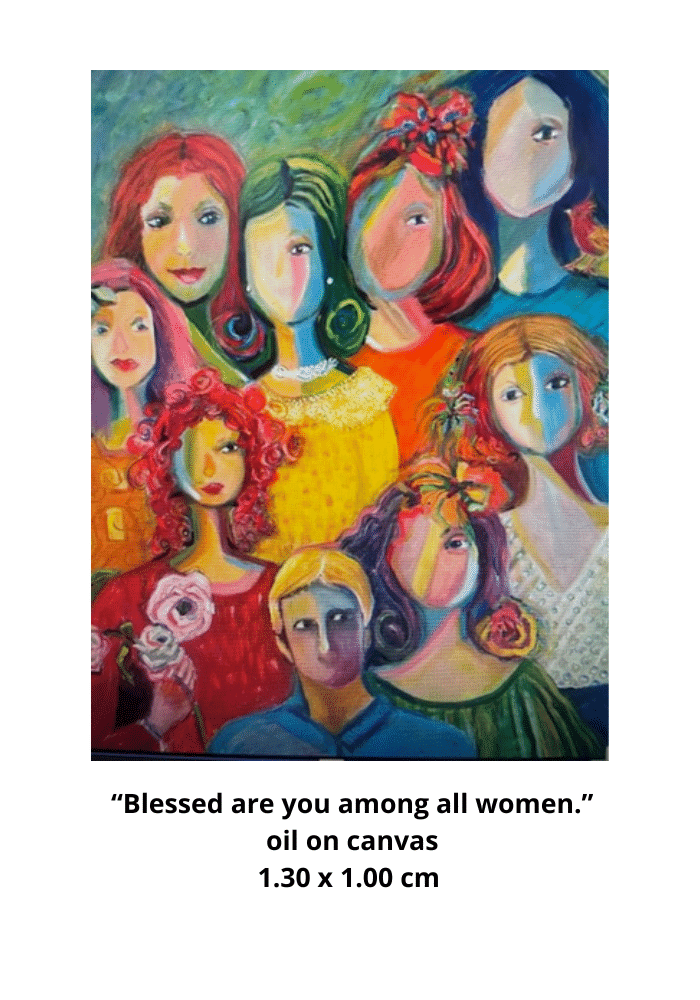
The same vocabulary enters a crowded portrait titled Bendito eres entre todas las mujeres. Its accompanying caption identifies eight women and one man, painted in oil on canvas The nine figures overlap in rising tiers, leaving little room for a setting outside their company.
The title translates as “Blessed are you among all women.” Its masculine adjective gives a playful turn to wording associated with the Hail Mary, whose Spanish text addresses Mary as blessed among women. That small grammatical change brings devotional language into a different social arrangement.
The man occupies the lower center in blue, immediately visible but not overwhelming. Above him, a bright yellow dress supplies another center of gravity. Red hair and clothing establish a competing vertical presence on the left. The caption’s numerical imbalance becomes a compositional negotiation rather than a simple declaration of who matters most.
For a Colombian audience, the pleasure can lie in hearing ceremonial language brought into conversation. The blessing becomes almost a remark offered across a room. It could suggest family, friendship, or imagined company, but the photograph does not establish those relationships. Instead, it shows a man surrounded by women who retain separate positions and gazes.
The gathering has the crowded closeness of a group photograph. Nobody has much room, yet the composition avoids placing every head on the same level. One woman holds roses; another wears a flower above her forehead. These details do not reveal biographies. They offer many small reasons to return.
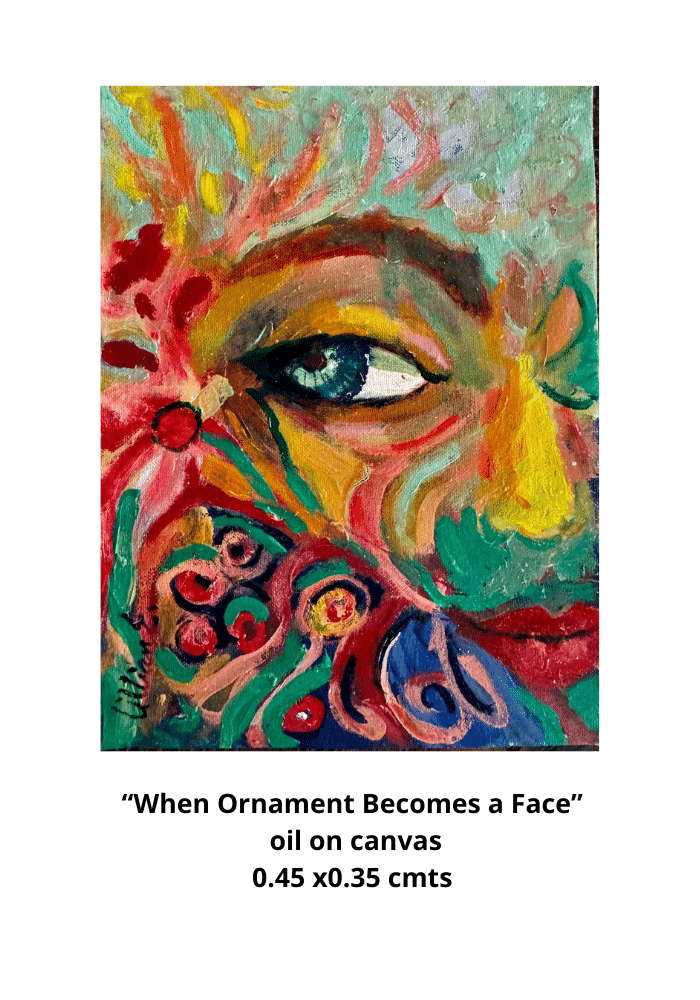
When Ornament Becomes a Face
An intimate close view of a face makes the connection to the gardens unmistakable. A blue eye, heavily outlined in dark paint, holds the center of attention. Around it, coral petals and turquoise curves flow into the cheek. The nose becomes a yellow shape; red lips meet blue and pink spirals below.
Here, ornament is not simply attached to a finished portrait. It helps construct the face. A curling stroke can describe a cheek, echo a petal, and then lose its descriptive role altogether. Unlike the group portrait’s broader divisions, these smaller turns keep recognition fluctuating. The eye remains legible even as the surrounding anatomy becomes a field of colored marks.
Taken together, the images show a recurring visual language rather than unrelated floral and human subjects. Spirals return as roses, curls, and facial decoration. Green connects bodies to their surroundings instead of staying obediently behind them. Espinosa’s strongest moments occur where that continuity makes the familiar slightly strange: a flower behaving like a face, or a face refusing to end at its outline.
Contact: +57 3126134720 – https://www.instagram.com/lillianespinosavega/