


Colombian Artist Lorena Rosas Dresses Childhood in Beautiful Memories That Refuse to Behave.
Colombian artist Lorena Rosas layers oil paint, organic matter, and natural pigments into quietly unsettling visions of childhood. Beneath their pastel surfaces, these paintings question how femininity is learned, how memory edits a life, and what innocence costs to preserve.
The Dress Remembers More
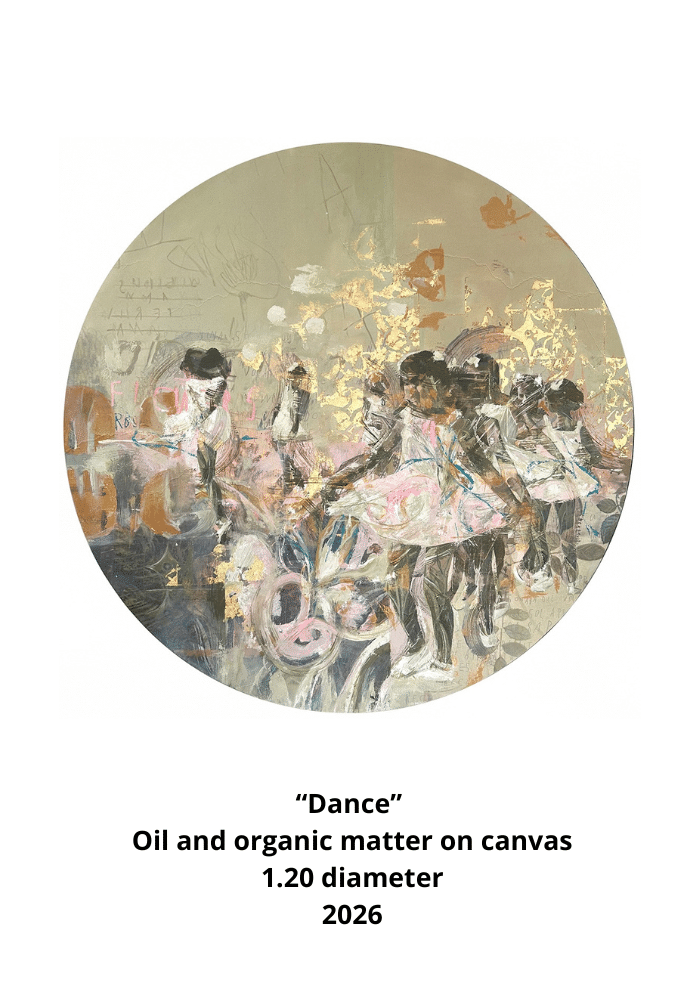
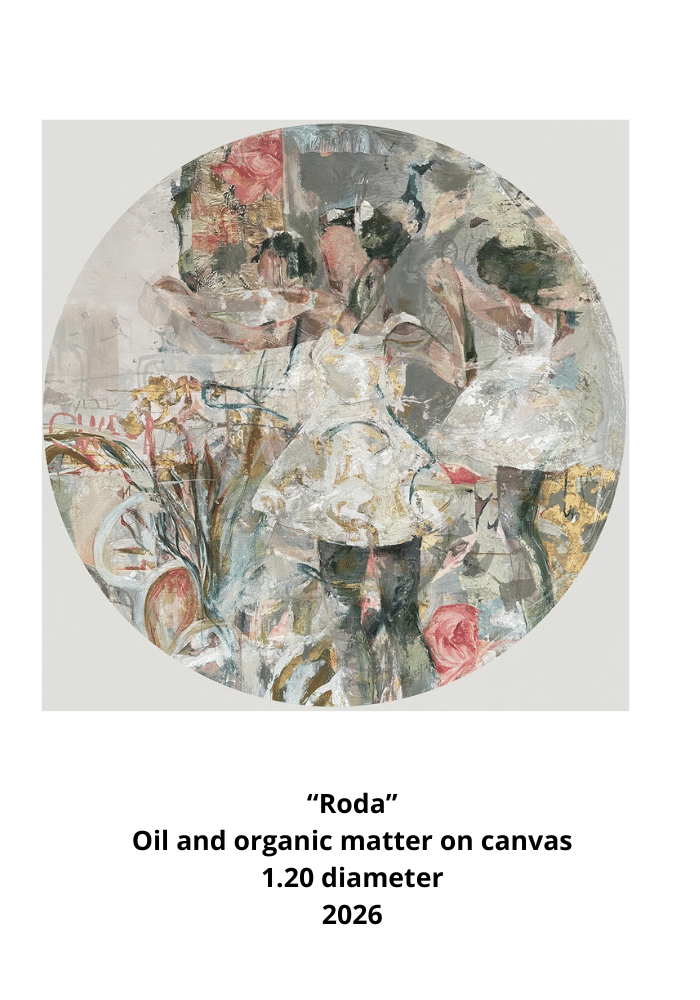
A girl reaches toward another figure, but her arm almost disappears into the pale commotion between them. Her skirt is easier to follow than her face. In “Dance”, movement survives more clearly than identity. We recognize the effort to join someone before we can determine exactly who is there.
Rosas builds this uncertainty through overlapping marks and uneven visibility. Dark heads punctuate the middle of the circular composition; pale dresses spread beneath them. Pink lines travel across bodies and surrounding space, loosening the separation between figure and background. Along the right edge, repeated oval shapes introduce an orderly beat beneath the hesitant choreography.
The circle contains the gathering without making it restful. Its perimeter bends around the figures, gathering them into something resembling a keepsake. Yet the lower half feels crowded, with legs, curls and patterned fragments competing for space.
The circle promises completeness. Her stated technique combines oil on canvas with organic matter, natural pigments, and translucent textures. The accumulated substance creates an appearance of fragility. Pale passages veil darker forms without completely extinguishing them.
The Garden Resists Classification
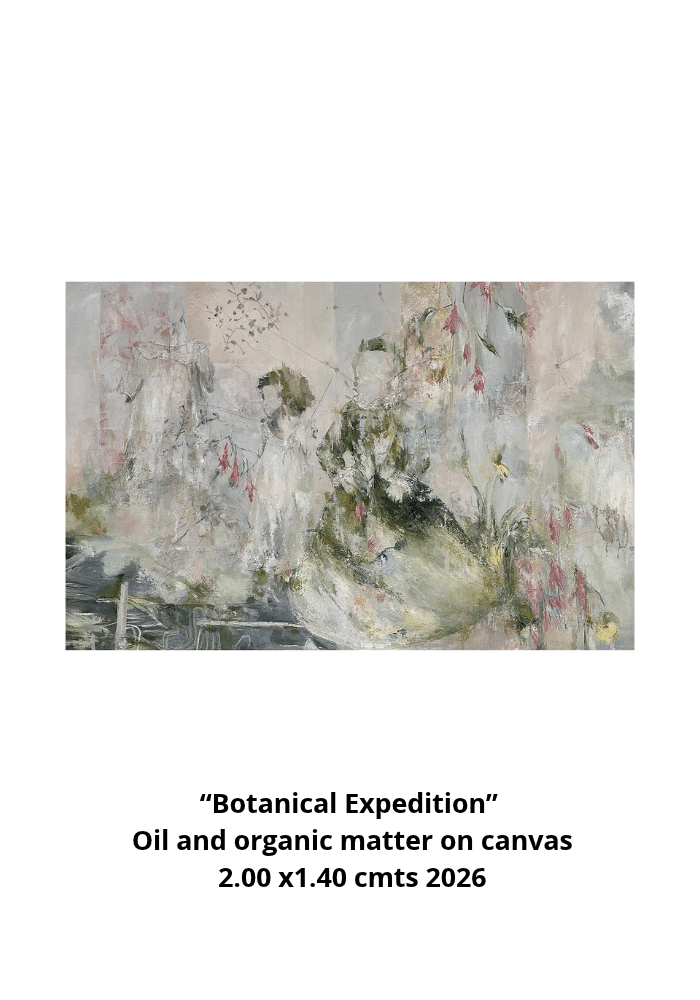
The rectangular image labeled ““Botanical Expedition”” offers a different kind of enclosure. Pale vegetation disperses through an open field, interrupted by darker concentrations near the center and lower edge. Thin stems and hanging reddish forms emerge, then lose definition. The eye keeps trying to distinguish plant from figure, vessel from surrounding growth.
A broad, rounded pale form anchors the lower center-right. Above it, dark strokes gather into something denser and less nameable.
In Colombia, the phrase “botanical expedition” carries a specific history. The Royal Botanical Expedition to New Granada began in 1783. Colombia’s National Museum explains that its illustrators depicted plants isolated from their surroundings, sometimes combining flowering and fruiting stages that occurred at different times. Scientific clarity required a carefully constructed image.
That comparison also has political weight. In 1816, Pablo Morillo ordered the expedition’s collections sent to Madrid in 105 crates, including twelve containing drawings, according to the museum. Images helped make American nature knowable.
Nothing in the supplied material establishes this painting as an explicit denunciation of that history.
Who Gets to Keep Their Innocence
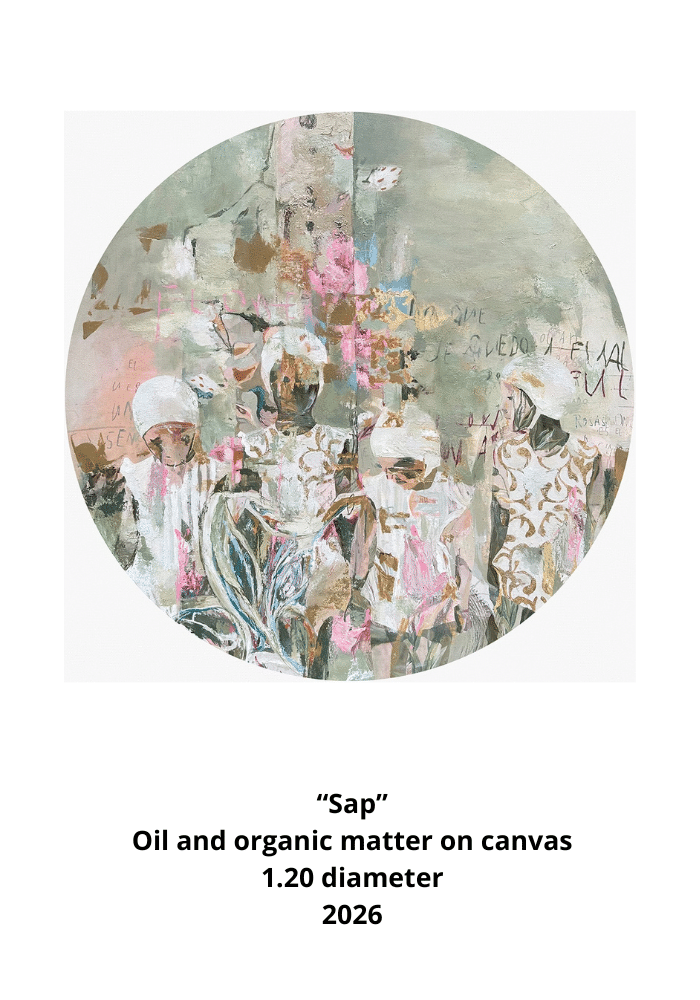
In the framed circular work, a central figure in a pale pink garment seems caught between presentation and disappearance. Dark vertical forms below anchor the body; slender leaves to the left compete with the clothing’s contours. A rose-colored spiral near the bottom offers a small, concentrated counterweight.
The garment dominates without stabilizing its wearer. This is where Rosas’s interest in femininity becomes formally persuasive. Another circular composition pushes that imbalance further. A relatively vacant upper field hangs above a crowded lower band of figures, lettering and botanical marks. The empty area creates a pause, but the bodies below remain pressed together. Space is plentiful in the picture and scarce where its inhabitants gather.
The letters suggest that language, too, has entered the remembered scene. Their partial legibility prevents an easy message. They behave like instructions imperfectly retained, or words whose emotional force has outlasted their precise wording. This remains an interpretation, sustained by their placement among the figures.
The softened palette risks making this uncertainty too comfortable. The most compelling passages resist through awkward overlaps and faces that will not resolve. Return to the reaching girl in “Dance. Her gesture remains available, her story unfinished. The painting leaves room for her to exceed the dress.
Lorena Rosas
Artista visual
www.lorenarosas.com
@lorenarosasart