

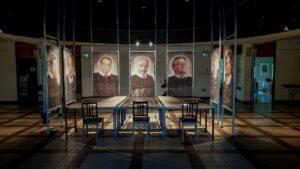
“Marmelade” Installation. paoloalmario.com
Colombian Artist Paolo Almario Dismantles Corruption as Power Crumbles Across the Dinner Table
In Marmelade, Paolo Almario turns Colombian jam, bread, robotic destruction, and judicial portraits into a participatory reckoning with corruption, family persecution, and failed institutions, asking visitors to consume a political metaphor. At the same time, power breaks apart before them at the table.
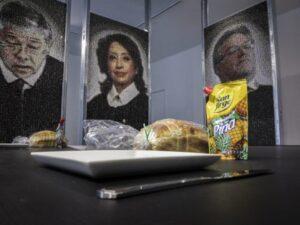
“Marmelade” Installation. paoloalmario.com
The Banquet Is Also Evidence
A pouch of pineapple jam stands beside a loaf of bread. A white plate waits. Chairs line a long black table. It could be an ordinary meal, except monumental faces hang inside metal frames, and machines are preparing to tear those faces apart.
That collision between domestic familiarity and institutional menace gives Paolo Almario’s Marmelade its first charge. The Colombian artist, who lives in Canada as a refugee, has built an installation that is dining room, tribunal, workshop, family memorial, and slow execution of an image. Visitors may sit, spread jam, eat bread, leave crumbs, and watch authority come down in pieces.
The title turns on Colombian political slang. “Mermelada” describes the clientelistic spreading of favors and power, distributed unevenly as jam crosses bread. Almario constructs that metaphor physically. The sweet food sits within reach while judicial portraits tower over the table. Eating becomes political theater, but also implication. The visitor cannot remain a morally clean observer. The visitor handles the metaphor, tastes it, and leaves residue behind.
The photographs make the imbalance palpable. The yellow jam package is bright, cheap, almost cheerful against the black table. Behind it, portraits hold the solemn frontal posture of official photographs. Their authority depends on thousands of printed labels, around 4,800 across the installation, cut by hand, attached to Plexiglas, and placed into precise recesses. From across the room, power coheres. Up close, it is packaging.
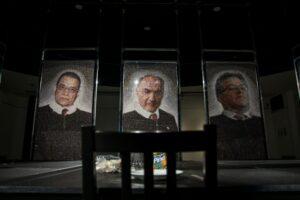
“Marmelade” Installation. Paolo Almario
A Portrait Built to Be Destroyed
The close view reveals the violence of the surface. Skin, hair, robe, and background are assembled from a commercial alphabet. Tiny colors lock together like pixels, scales, files, or votes. Some pieces jut outward or have vanished, leaving black interruptions across a face. The image has begun to fail, and failure exposes how it was built.
That is the installation’s sharpest aesthetic argument. Almario takes the photo mosaic, a form often associated with commemoration, and gives it a death sentence. Seven robotic machines gradually dismantle seven portraits linked to Colombia’s judicial and state apparatus. They do not strike in anger. They proceed systematically. Their cold repetition recalls institutional harm, where a life may be broken through documents, signatures, hearings, delays, and decisions repeated until damage feels procedural.
The work grew from the political persecution of Almario’s family and the legal case against his father, whom the artist describes as having spent nine years imprisoned on false accusations before his release in 2016. In Marmelade: The Supreme, the portraits represent magistrates associated with those proceedings. The version emerged from activism intended to draw international attention to the case, and it has been rebuilt and destroyed at successive exhibitions.
Biography keeps the piece from becoming a clever machine about corruption in general. A family sits beneath every robotic movement. Exile sits there too. The table carries the intimacy of a home invaded by public institutions. These portraits hang like ancestors in a dining room, except they are preserved not by affection, but because forgetting would repeat the injury.
Still, the installation avoids the language of revenge. The robots destroy representations, not bodies. Each portrait must be produced anew with the presenting venue before it can be dismantled again. Memory is reconstructed before release. Anger becomes labor, timing, collaboration, and method.
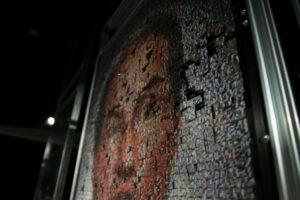
“Marmelade” Installation. paoloalmario.com
When Redistribution Falls to the Floor
As the machines work, fragments descend onto the table and gallery floor, mixing with crumbs and jam left by visitors. High office becomes litter. The portrait loses its vertical privilege and enters the horizontal world of appetite, waste, and public contact. What represented concentrated authority is symbolically returned to ordinary people, not as a clean civic gift, but as debris after a meal.
The chairs make spectatorship bodily. A museum visitor usually passes an artwork while protected by distance. Here, someone must decide whether to sit. The empty seats resemble a jury box, a family supper, or places held for absent witnesses. The black table cuts through the room like both stage and barrier. Behind it, steel frames evoke court architecture, prison construction, and the exposed skeleton of a house.
That unfinished feeling belongs to the work’s public afterlife. Ars Electronica selected Marmelade for the 2026 State of the ART(ist) grand prize, worth 6,000 euros, from 561 submissions across 86 countries. The installation is scheduled for the festival’s Negotiating Humanity exhibition in Linz from September 9 through 13. Organizers positioned the award at the intersection of art, activism, human rights, and resistance when institutions fail.
Yet Marmelade matters beyond an award because it understands corruption as a sensory system. Corruption has language, texture, choreography, and taste. It can arrive in judicial robes while operating through distribution. It can appear solid from a distance and fragment under scrutiny. It can enter a home, scatter a family, and send an artist across borders carrying the problem into another public room.
Almario offers no purification. The jam remains sweet. The crumbs remain messy. The machines are only as just as the instructions they receive. What the work offers is altered scale. Officials become labels. Labels become fragments. Fragments fall within reach of ordinary hands.
At this table, power is no longer an abstraction. It is spread, consumed, watched, and finally made to lose its face.